Overhead Crane vs Gantry Crane: What Is the Difference and How to Choose the Right Lifting Solution?
When planning an efficient material handling system for a manufacturing facility or outdoor yard, industrial buyers often ask a fundamental question:
What is the difference between an overhead crane and a gantry crane, and which one is right for my application?
Because both crane types perform similar core functions—lifting, moving, and positioning heavy loads—it is easy to assume the difference is merely structural. However, as the engineering team at Cranox often points out to our global clients, choosing between an overhead crane and a gantry crane involves much more than equipment design. It directly impacts your workshop space utilization, installation costs, structural requirements, operational efficiency, and future business scalability.
Selecting the wrong lifting solution can result in unnecessary building reinforcement costs or restricted workflow. This guide breaks down the key technical differences, installation requirements, and practical applications to help you make an informed decision for your facility.
Quick Comparison: Overhead Crane vs. Gantry Crane
01. What Is an Overhead Crane?
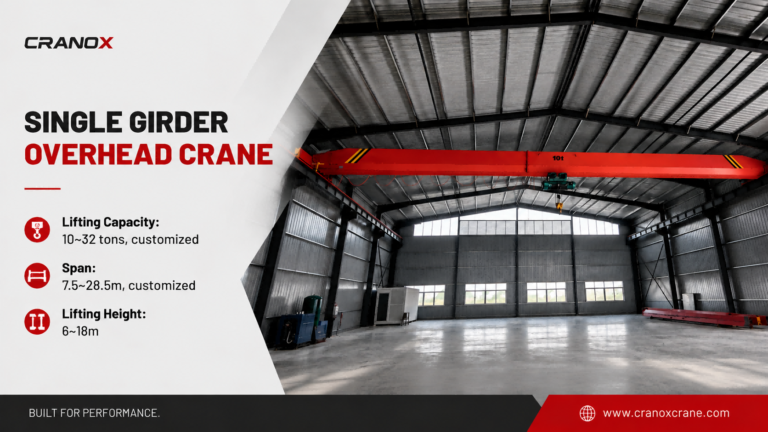
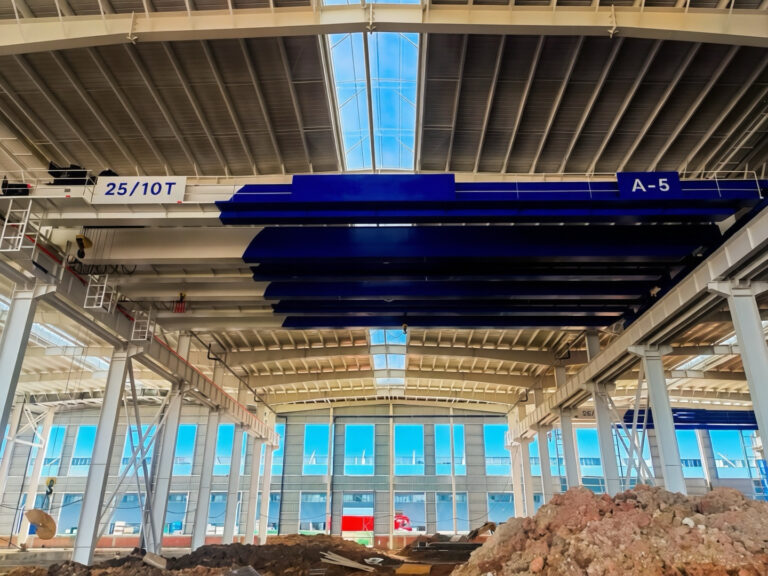
An overhead crane (commonly referred to as a bridge crane) is an indoor industrial lifting system that travels along elevated runway beams mounted to a building’s support structure.
The crane bridge moves horizontally along the elevated runway, while the hoist moves across the bridge to lift and lower loads. Because it utilizes upper building space, a Cranox overhead crane completely frees up valuable floor area for production machinery, storage, and worker movement.
Key Applications for Overhead Cranes:
-
Manufacturing Plants: Moving heavy components across processing stations.
-
Automotive & Equipment Assembly: Precise positioning of engines and frames.
-
Machinery & Tooling Workshops: Loading/unloading heavy steel materials and finished parts.
-
Warehouses & Steel Processing Centers: High-density indoor material storage.
02. What Is a Gantry Crane?
A gantry crane is an industrial lifting system supported by custom-engineered vertical legs that move along ground-level rails or heavy-duty rubber tires (RTG cranes).
Unlike overhead cranes, a gantry crane does not rely on a building’s structural steel or ceiling support. Its freestanding design makes Cranox gantry cranes an ideal solution for outdoor applications or facilities where indoor building runways are structurally unfeasible.
Key Applications for Gantry Cranes:
-
Outdoor Storage & Freight Yards: Handling steel coils, pipes, and precast concrete blocks.
-
Ports, Logistics & Container Terminals: Stacking and loading shipping containers.
-
Shipbuilding & Structural Fabrication: Assembling large structural steel components.
-
Rented Facilities: Applications where modifying the building frame is not permitted.
03. Key Differences Between Overhead Cranes and Gantry Cranes
While both crane solutions handle heavy-duty lifting, four major factors distinguish them:
1. Installation & Structural Requirements
-
Overhead Crane: Requires a structurally sound building capable of supporting the combined weight of the runway beams, crane bridge, hoist, and maximum rated load. If your facility lacks heavy-duty columns, retrofitting can significantly increase installation costs.
-
Gantry Crane: Operates independently of the building framework. Installation requires only a flat, stable ground surface and floor tracks (or rubber-tired mobility).
2. Floor Space Utilization
-
Overhead Crane: Maximizes upper space utilization. By lifting loads entirely above the work zone, it leaves the floor clear for forklift paths, safety zones, and machinery layout.
-
Gantry Crane: Utilizes ground-level operating space. Floor space must accommodate rail track layout and wheel travel channels, requiring clear paths along the perimeter of the work area.
3. Mobility and Flexibility
-
Overhead Crane: Permanently integrated into the building architecture. Relocating an overhead crane to a new facility requires disassembling runway beams and structural supports.
-
Gantry Crane: Highly modular. Portable or rubber-tired gantry cranes engineered by Cranox can easily be relocated within a facility or transported to a new job site.
4. Outdoor vs. Indoor Performance
-
Overhead Crane: Primarily optimized for climate-controlled indoor operations.
-
Gantry Crane: Specially engineered with weather-resistant components (protective covers, IP-rated enclosures, storm locks) to perform reliably in harsh outdoor environments.
04. Real-World Scenarios: The Cranox Selection Logic
To understand how selection works in practice, consider two common industrial scenarios where Cranox delivers customized solutions:
-
Scenario A (Indoor Precision Manufacturing): A machine tool manufacturer operates inside an enclosed factory and needs to transport engine blocks along a 100-meter assembly line. Floor space is packed with CNC machines.
-
The Cranox Solution: A custom-designed Overhead Crane. It lifts loads above the machinery, keeps aisles clear, and seamlessly integrates into the building’s existing structural columns.
-
-
Scenario B (Outdoor Heavy Fabrication): A structural steel contractor needs to store and load 20-meter steel beams in an open yard. The site has no surrounding building structure.
-
The Cranox Solution: A heavy-duty Gantry Crane. It operates independently on ground rails, provides wide-span coverage across the yard, and avoids the high cost of building an artificial runway enclosure.
-
05. How to Choose the Right Crane Solution for Your Facility
When evaluating lifting equipment for your next project, our engineering team at Cranox recommends considering the following crucial questions:
-
Where will the crane operate? (Indoor workshop vs. outdoor yard)
-
Can your building structure support runway loads? (Or will column retrofitting exceed your budget?)
-
What are your exact lifting requirements? (Rated capacity, lifting height, and span length)
-
How critical is floor space to your workflow? (Do you need 100% obstruction-free floor space?)
-
Are your operations permanent or temporary? (Do you own or lease the building?)
Summary Checklist:
-
Choose an Overhead Crane if: You have a strong indoor facility, limited floor space, and require continuous high-speed material handling across a fixed production area.
-
Choose a Gantry Crane if: You operate outdoors, work in a rented facility, need mobility, or want to avoid expensive building structural modifications.
Optimize Your Material Handling with Cranox
Selecting the right industrial crane is not just about choosing an equipment type—it is about designing a material handling system tailored to your building, workflow, and long-term production goals.
At Cranox, we specialize in designing and manufacturing high-performance overhead and gantry cranes tailored to your precise operational needs. From site evaluation and load analysis to custom manufacturing and installation support, Cranox provides end-to-end lifting solutions.
Ready to upgrade your material handling efficiency?
[Contact the Cranox Engineering Team Today] for a custom technical assessment, layout drawing, or a direct quote on your next crane project!