
Overhead Crane Selection Guide: Should You Choose Based on Your Product or Your Factory?
When investing in industrial lifting equipment, many customers ask a seemingly simple question: Should an overhead crane be selected according to the products being handled, or according to the factory building?
The short answer from our engineering team at Cranox is: Neither one alone.
A suitable overhead crane system is determined by the lifting task first, and then verified and adapted to the building dimensions and structural conditions. In other words, your products and production process define what the crane needs to do, while your factory determines how that crane can be installed and operated safely.
A crane should never be selected solely because a workshop has a certain width, nor should a 20-ton bridge crane be specified just because your heaviest component weighs 20 tons. Here is how Cranox recommends navigating the overhead crane selection process for optimal safety, compliance, and ROI.

01. Start With What the Crane Actually Needs to Lift
The first step in industrial crane selection is understanding the specific material handling application. The critical question isn’t just “What is the maximum weight?” but also:
-
What exact materials are being lifted?
-
How frequently will the crane operate (duty cycle)?
-
Where does the load need to be moved, and how is it rigged?
For example:
-
Steel Fabrication Workshops: Frequently move raw steel plates, welded structures, and heavy finished assemblies.
-
Machinery & Equipment Plants: Require precise positioning for engines, molds, CNC machine tools, and components.
-
Maintenance Facilities: May only need an overhead crane occasionally for intermittent equipment servicing.
These distinct applications demand completely different crane configurations, even when the maximum load capacity is identical. Essential factors like lifting capacity, hook height, span, hoisting speed, crane duty class (CMAA/FEM standards), control methods, and specialized lifting attachments must all be tailored to your process.
At Cranox, we align with international industry specifications such as CMAA and ASME B30.2 (which covers top-running overhead and gantry cranes). We treat crane selection as a comprehensive engineering process rather than a simple off-the-shelf purchase.
02. Evaluate Your Factory Building Conditions & Clearances
Once your lifting requirements are clearly defined, the next step is determining whether your existing or planned facility can accommodate the crane system.
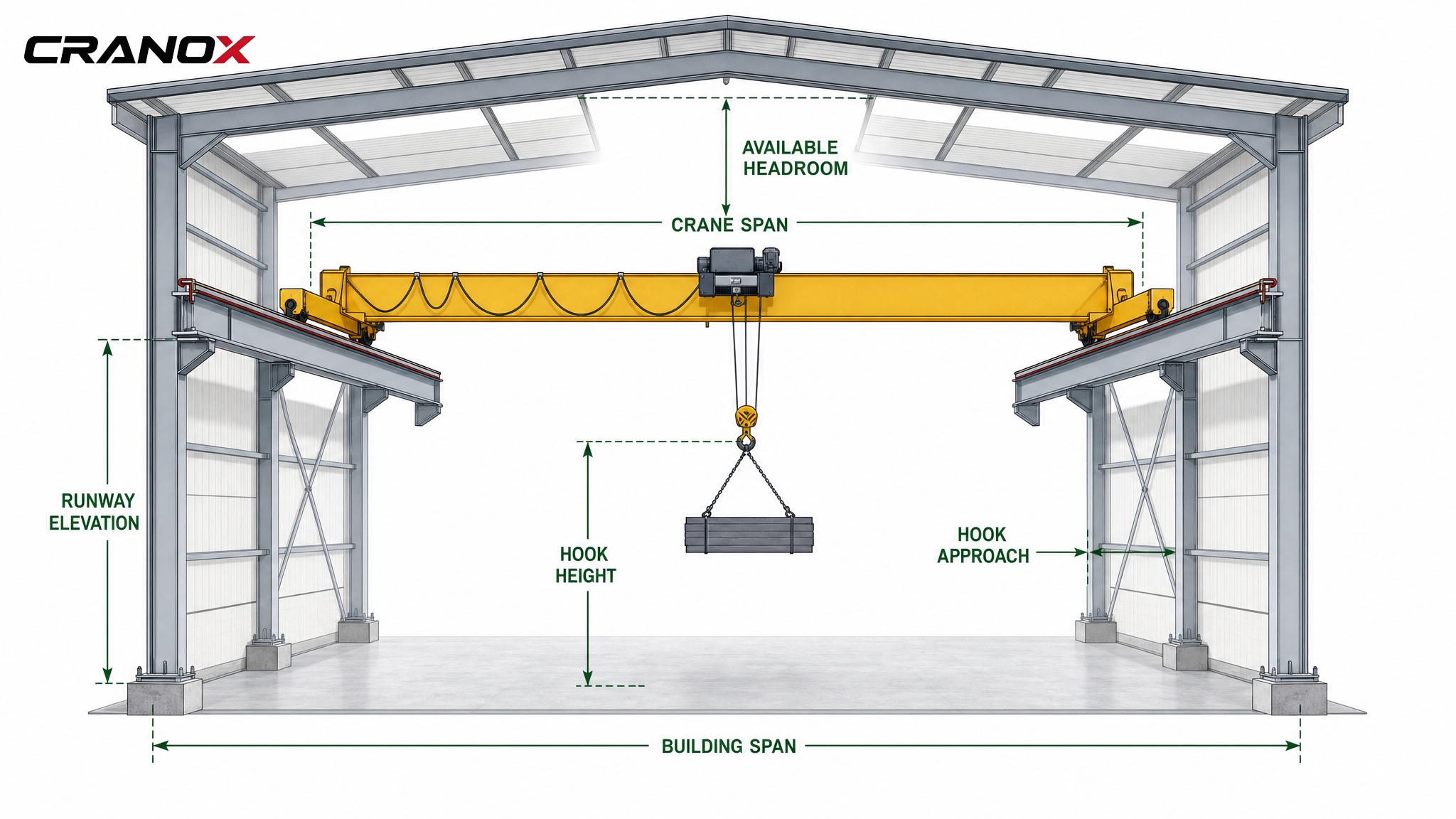
Key building dimensions that impact overhead traveling crane installation include:
-
Building span & runway rail span
-
Available headroom (clearance above the crane)
-
Runway rail elevation & hook approach limits
-
Building column spacing, travel length, and side clearances
A common misconception in factory planning is that the crane span equals the width of the workshop. In reality, the crane span is measured between the centers of the runway rails, while the usable lifting coverage depends on crane geometry, hook approaches, and physical obstacles.
Structural Capacity & Runway Rail Support
A top-running bridge crane transfers substantial static and dynamic wheel loads to the runway rails and building columns. Therefore, the supporting steel structure, runway beams, connections, and foundations must be engineered to handle these forces.
Even if a developer advertises a building as “crane-ready,” Cranox engineers always perform a rigorous structural audit to verify wheel loads, crane dead weight, and deflection limits against the building’s design.
03. Same Capacity ≠ Same Structural Requirement
Consider two 10-ton overhead cranes:
-
Crane A operates occasionally in a light maintenance bay.
-
Crane B operates continuously in a high-speed, heavy-duty manufacturing line.
Although both carry a rated capacity of 10 tons, their structural impact on the building is vastly different. Crane B requires a higher duty classification, heavier structural girders, larger end trucks, and generates significantly higher dynamic forces during acceleration and braking.
Saying “the facility supports a 10-ton crane” is not precise enough. Cranox engineers calculate exact runway stiffness, vertical deflection, and lateral impact forces according to CMAA design criteria to safeguard your structural infrastructure.
04. Selecting an Overhead Crane for an Existing Building
If your facility is already constructed, the engineering selection process adapts to fixed physical constraints:
-
Define the Task: Establish load weight, lifting height, operating duty, and coverage area.
-
Measure & Audit: Audit the building geometry, column strength, and structural runway capacity.
-
Adapt the Solution: If existing roof trusses or columns cannot safely support a standard top-running crane, simply reducing lifting capacity isn’t the only option.
In these cases, Cranox offers tailored alternative lifting solutions, such as:
-
Freestanding Independent Runway Systems
-
Semi-Gantry Cranes or Floor-Supported Gantry Cranes
-
Underhung (Underslung Bridge) Cranes
-
Slewing Jib Cranes or Workstation Cranes
The takeaway: The existing building creates constraints, but it should never dictate or compromise your core operational lifting needs.

05. Coordinated Planning for New Factory Construction
For new workshop projects, coordinating the crane design with the facility layout early in the architectural process saves significant time and money.
If your production plan calls for a 20-ton crane down the road, designing the building structure first and adding the crane later often leads to costly retrofits. Common issues include insufficient hook height, inadequate side clearances, improper column placement, or foundation under-design.
By partnering with Cranox during the architectural phase, the crane system and factory building are engineered as one unified system. We provide exact wheel loads, runway elevations, duty cycles, power supply specs, and clearance envelopes before building steel fabrication begins.
06. The Final Verdict: Product or Factory First?
Choose the crane according to the lifting task, then verify and adapt it to the factory building.
Neither the product nor the building can be evaluated in isolation. The product defines performance; the building defines space and structural boundary limits.
How to Request an Accurate Crane Quotation from Cranox
To get the most reliable, cost-effective, and safe overhead crane solution, try to provide more than just “10-ton crane needed.” Helpful details to include:
-
Rated Load Capacity & Max Duty Cycle: (e.g., 10 Ton, 8 hours/day)
-
Required Lifting Height & Hook Approach
-
Facility Dimensions: Runway rail span, building length, available headroom
-
Operating Environment: Indoor, outdoor, high heat, explosive/chemical, etc.
-
Material Type: Steel coils, dies, bulk goods, general assembly
Ready to optimize your material handling efficiency? Contact the engineering team at Cranox today for a customized technical consultation and overhead crane proposal tailored to your application and facility.



 English
 Español
 Русский