Single Girder vs Double Girder Overhead Crane: What Is the Difference and How to Choose?
When engineering an industrial material handling system, factory managers and equipment buyers frequently ask: What is the difference between a single girder and a double girder overhead crane, and which design best suits my facility?
While both crane configurations lift, lower, and transport heavy loads, the choice between them involves much more than simply counting the main bridge girders. At Cranox, our engineers emphasize that girder configuration directly impacts structural weight, trolley arrangement, effective hook height, building clearance, duty classification, and long-term operating costs.
Assuming that lifting capacity alone determines crane selection can lead to costly structural over-engineering or inadequate performance. This guide breaks down the technical differences, space utilization factors, and engineering criteria to help you select the ideal overhead crane for your application.
Quick Comparison: Single Girder vs. Double Girder Overhead Crane
| Feature / Parameter | Single Girder Overhead Crane | Double Girder Overhead Crane |
| Main Girder Design | One steel bridge girder | Two parallel steel bridge girders |
| Hoist / Trolley Mount | Under-running (suspended underneath girder) | Top-running (travels on top of girders) |
| Typical Capacity Range | Light to medium-duty (Typically 1 to 20 Tons) | Heavy-duty (Typically 5 to 500+ Tons) |
| Effective Hook Height | Standard (Hoist hangs below main girder) | Maximized (Hoist sits between/above girders) |
| Structural Deadweight | Lighter bridge weight; lower runway wheel loads | Heavier bridge weight; requires robust runways |
| Duty Classification | Light to Moderate (ISO M3–M5 / FEM 1Am–2m) | Heavy to Severe (ISO M5–M8 / FEM 2m–5m) |
| Cranox Application Fit | General manufacturing, assembly, & storage | Steel mills, heavy fabrication, & high-frequency plants |
01. What Is a Single Girder Overhead Crane?
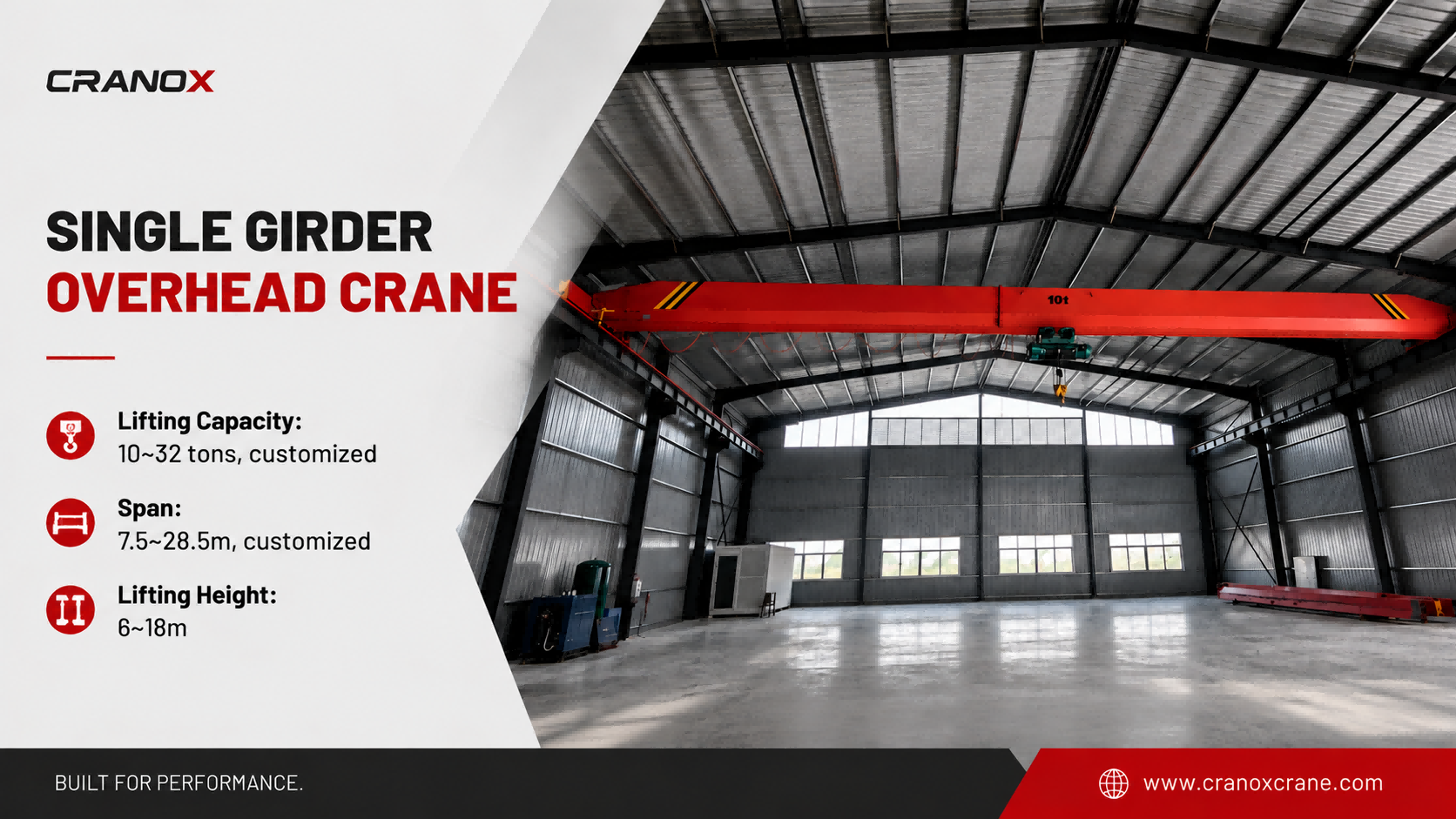
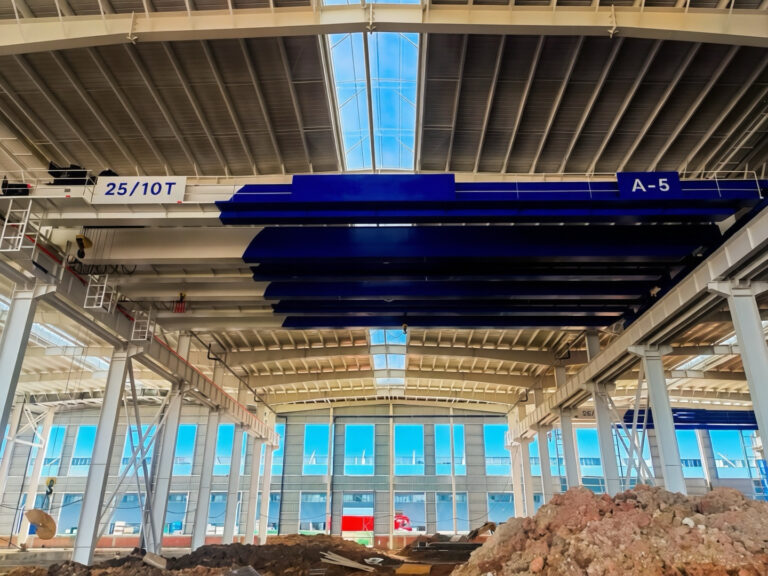
A single girder overhead crane utilizes a single main bridge girder supported by end trucks on elevated runway beams. An electric wire rope or chain hoist operates along the bottom flange of the main girder (or under-running trolley system).
Because of its compact and lightweight design, a Cranox single girder overhead crane provides a highly cost-effective lifting solution for light to medium-duty applications. It minimizes wheel loads on existing building columns and runway structures, making it easier to install into standard industrial workshops.
Ideal Applications for Single Girder Cranes:
-
Machinery & Tooling Workshops: Moving raw stock, tooling dies, and finished parts.
-
Light Manufacturing & Assembly Lines: Steady material flow between processing stations.
-
Maintenance & Repair Bays: Intermittent lifting of heavy equipment components.
-
Warehouses & Logistics Hubs: General indoor material staging.
02. What Is a Double Girder Overhead Crane?
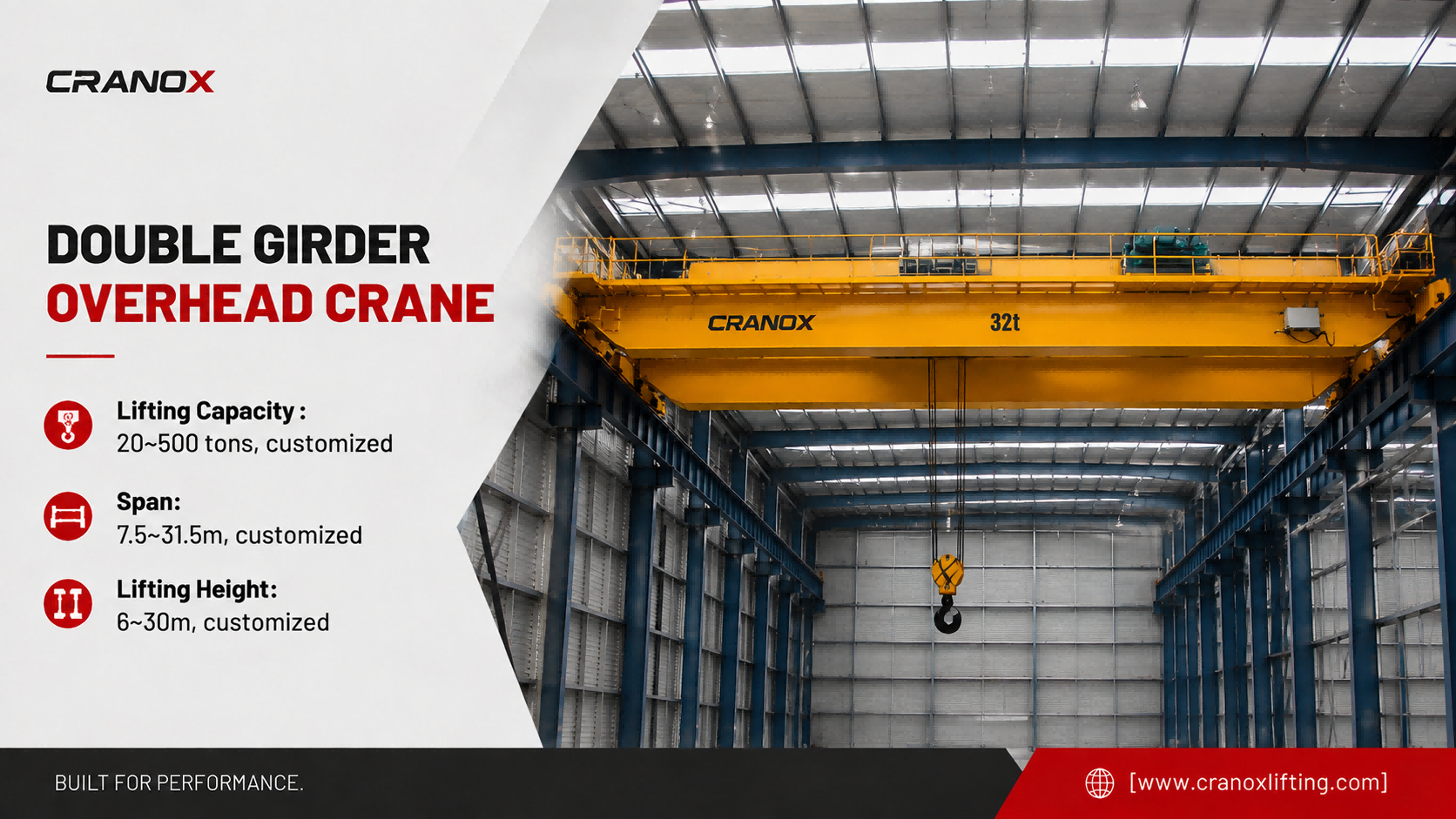
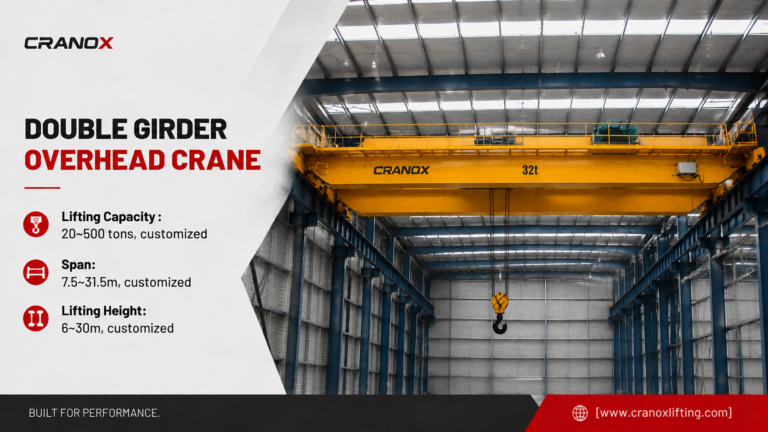
A double girder overhead crane consists of two parallel main bridge girders. The crane trolley and hoisting mechanism travel on top of rails mounted to the upper surface of the bridge girders (top-running configuration).
This structural layout allows Cranox double girder overhead cranes to handle much higher load capacities, wider spans, and severe working duty classes. Because the hoisting crab sits on top of the girders rather than hanging beneath them, double girder systems gain valuable vertical space, offering superior effective hook height inside facilities with tight overhead clearance.
Ideal Applications for Double Girder Cranes:
-
Heavy Steel Fabrication & Foundries: Handling liquid metal, slabs, and heavy structural steel.
-
Paper Mills & Power Generation Plants: Precise positioning of heavy turbines and rollers.
-
High-Frequency Automotive Stamping: Heavy die handling under continuous operation (FEM 3m/4m).
-
Wide-Span Facilities: Workspaces requiring spans exceeding 30 meters.
03. Key Differences Between Single and Double Girder Cranes
While capacity is a starting point, choosing between single and double girder designs requires evaluating four critical technical parameters:
1. Hoist Arrangement and Effective Hook Height
-
Single Girder: The hoist hangs below the main girder. The maximum hook height is limited by the vertical depth of the girder plus the hoist body.
-
Double Girder: The hoist crab rides on top of the bridge. The hook can travel up between the two girders, delivering maximum usable hook height within the same building ceiling clearance.
2. Building Structural Loading (Wheel Load)
-
Single Girder: Features a lighter total deadweight. This reduces the mechanical load on runway beams, support columns, and building foundations, lower overall facility construction costs.
-
Double Girder: Transfers higher deadweights and wheel loads to the building structure. It requires robust runway beams and heavy-duty structural steel columns.
3. Span and Duty Classification
-
Single Girder: Best suited for moderate spans (typically up to 22–30 meters) and moderate operating frequencies.
-
Double Girder: Ideal for long spans (30+ meters) and heavy-duty classifications (ISO M6–M8 / CMAA Class E/F) that require heavy-duty maintenance platforms, walkways, and auxiliary hoists.
4. Maintenance and Walkway Access
-
Single Girder: Maintenance on the hoist is generally conducted from elevated lifts or basic service platforms.
-
Double Girder: Easily outfitted with full-length maintenance walkways, handrails, and service platforms along the girders, allowing safer, easier maintenance access.
04. Real-World Decision Examples: Capacity Is Only the Beginning
Consider two facilities that both require a 10-ton overhead crane:
-
Facility A (General Machinery Assembly):
-
Conditions: 18-meter span, 8-hour daily shift, standard building height.
-
The Cranox Solution: A Single Girder Overhead Crane. It easily handles 10 tons within a moderate duty cycle, keeping initial equipment and structural costs low.
-
-
Facility B (Heavy Steel Service Center):
-
Conditions: 32-meter span, 24/7 continuous operation, tight ceiling clearance requiring maximum lift height.
-
The Cranox Solution: A Double Girder Overhead Crane. Although the capacity is also 10 tons, the wide span, continuous duty cycle, and hook height requirements dictate a double girder design for structural stability and longevity.
-
05. How to Choose the Right Overhead Crane for Your Facility
When specifying an overhead crane system with your engineering team or equipment manufacturer, evaluate these core parameters:
-
Rated Load Capacity: What is the maximum load, and what is your average lifting weight?
-
Crane Span & Lifting Height: What is the distance between runway rails, and how high must the hook travel?
-
Duty Cycle & Working Frequency: How many hours per day will the crane operate, and how many lifts per hour?
-
Building Clearances: What is the distance from the floor to the lowest overhead obstruction?
-
Auxiliary Needs: Do you require secondary hoists, maintenance walkways, or explosion-proof fittings?
Summary Checklist:
-
Choose a Single Girder Crane if: Your capacity is under 20 tons, spans are moderate, building clearance is adequate, and budget optimization is a priority.
-
Choose a Double Girder Crane if: You require capacities over 20 tons, long spans, maximum hook height, severe duty cycles, or heavy maintenance access platforms.
Custom Overhead Crane Engineering by Cranox
Selecting between a single girder and double girder crane isn’t about choosing the biggest equipment—it is about matching structural design to your operational workflow, building architecture, and budget.
At Cranox, we design, manufacture, and test custom overhead crane systems tailored to your plant layout and duty requirements. From initial wheel load calculations and building clearance modeling to global delivery and installation support, Cranox provides reliable industrial lifting solutions.