
What Is Crane Span and Why Does It Affect Equipment Selection?
When selecting an overhead crane or gantry crane, customers often focus on lifting capacity and lifting height. Another important parameter, however, is crane span.
Crane span is sometimes confused with workshop width, but they are not necessarily the same. Span determines the horizontal working area that a crane can cover and can also affect the crane structure, building requirements, and overall equipment configuration. So, what exactly is crane span, and how should it be selected?
01 What Is Crane Span?
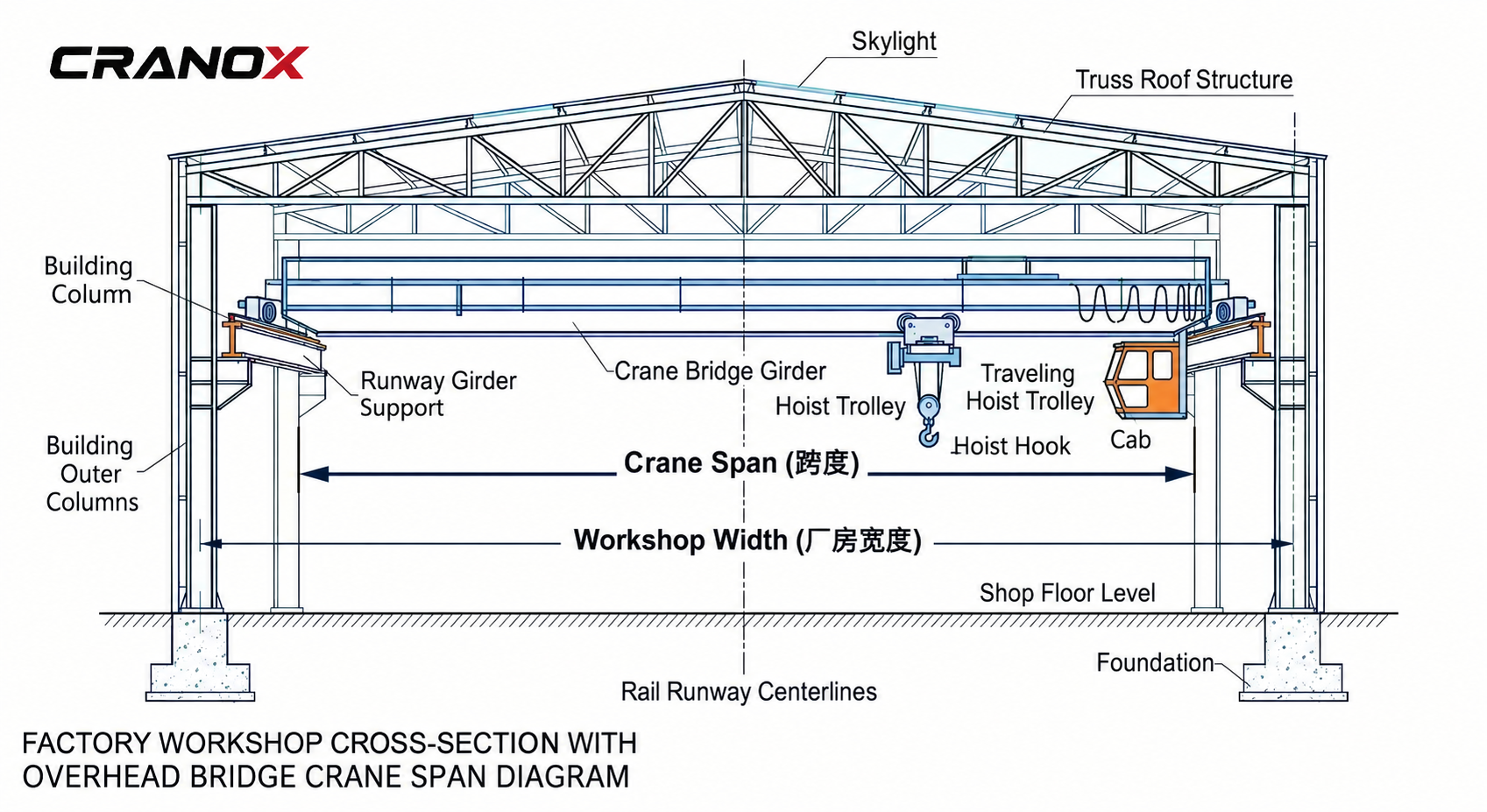
For an overhead crane, crane span generally refers to the horizontal distance between the centerlines of the two runway rails. In simple terms, it determines how far the crane bridge can extend across the working area.
For example, an overhead crane with a 20-meter span has an approximate 20-meter distance between the centerlines of its two runway rails. The crane travels longitudinally along the runway while the bridge moves across the workshop, allowing the hook to reach different lifting positions.
It is important to understand that crane span is not the same as workshop width. Building columns, runway positions, equipment layout, and required clearances can all affect the final span. For a gantry crane, span generally refers to the distance between the two legs and is also determined by the required working area and site conditions.
02 Why Does Crane Span Affect Crane Selection?
The most direct function of crane span is to determine how much of the working area the crane can cover horizontally.
If the span is too small, some lifting positions may be outside the crane’s working range. If it is significantly larger than necessary, it may increase the structural requirements of the bridge, legs, or building support system. Therefore, a larger span is not automatically better; it should match the actual working area.
Span also needs to be considered together with lifting capacity, lifting height, duty class, and operating frequency. For example, two overhead cranes may both have a 10-ton lifting capacity, but if one has a 10-meter span and the other has a 25-meter span, their structural design requirements will not necessarily be the same.
This is why crane selection is not only about how much weight the crane can lift, but also how large an area it needs to cover.
03 How Is Crane Span Related to Building Structure?

For an overhead crane, the runway system normally relies on the building structure or dedicated supporting structures. The crane span therefore needs to match the building columns, runway position, and available clearance.
If a crane is being installed in an existing workshop, the actual building dimensions and structural conditions should be checked before determining the span. If the crane is considered during the workshop design stage, the runway, supporting structure, and crane operating space can be planned in advance.
For a gantry crane, the crane travels on ground rails through its legs, so the span also needs to be considered together with site roads, equipment layout, and the working space between the legs.
This is why crane span is not simply an equipment dimension; it is an important connection between the crane and the working environment.
04 Why Can the Same Lifting Capacity Require Different Spans?
Consider two manufacturing companies that both need a 10-ton overhead crane.
The first factory has a main working area approximately 12 meters wide, so the crane only needs to cover this area. The second factory needs to cover a production area approximately 24 meters wide. Although both cranes have the same lifting capacity, their required spans are different, which means their bridge structures, building conditions, and overall configurations also need to be evaluated separately.
This shows that crane parameters do not exist independently. The same lifting capacity does not necessarily mean the same span or structural configuration.

05 How Do You Determine the Right Crane Span?
When determining crane span, it is better to start with the actual lifting area rather than selecting a number directly from a standard crane model.
First, identify the area that the crane needs to cover. Then consider the workshop width, column positions, runway arrangement, and surrounding equipment. Finally, evaluate the span together with lifting capacity, lifting height, travel distance, operating frequency, and the type of material being handled.
A practical selection process can be summarized as:
Actual working area → Building/site conditions → Crane span → Lifting and operating requirements → Final crane configuration
06 The Right Span, Not the Largest Span
Crane span may look like a simple dimension, but it directly affects the crane’s coverage and can influence the design of the entire lifting system.
Therefore, when selecting an overhead crane or gantry crane, it is more useful to ask “How large an area does the crane need to cover, and what span can the site support?” rather than simply asking how large the crane span can be.
As a crane and lifting equipment manufacturer based in China, Cranox evaluates crane span together with the customer’s building structure, working area, lifting capacity, and actual operating requirements to develop a more suitable crane solution.




 English
 Español
 Русский