
Wire Rope Hoist vs Chain Hoist: Key Differences and How to Choose
Choosing between a wire rope hoist and a chain hoist is an important decision when selecting lifting equipment for industrial applications. Both are widely used in factories, warehouses, workshops, and material handling systems, but they differ in lifting mechanisms, capacity ranges, operating characteristics, and maintenance requirements.
A wire rope hoist typically uses a steel wire rope wound around a drum, while a chain hoist lifts loads through a calibrated load chain and sprocket mechanism. These differences influence lifting height, speed, equipment dimensions, and suitability for different working conditions.
Understanding the differences between a wire rope hoist vs chain hoist can help engineers, equipment buyers, and facility managers select a suitable lifting solution.
01. What Is a Wire Rope Hoist?
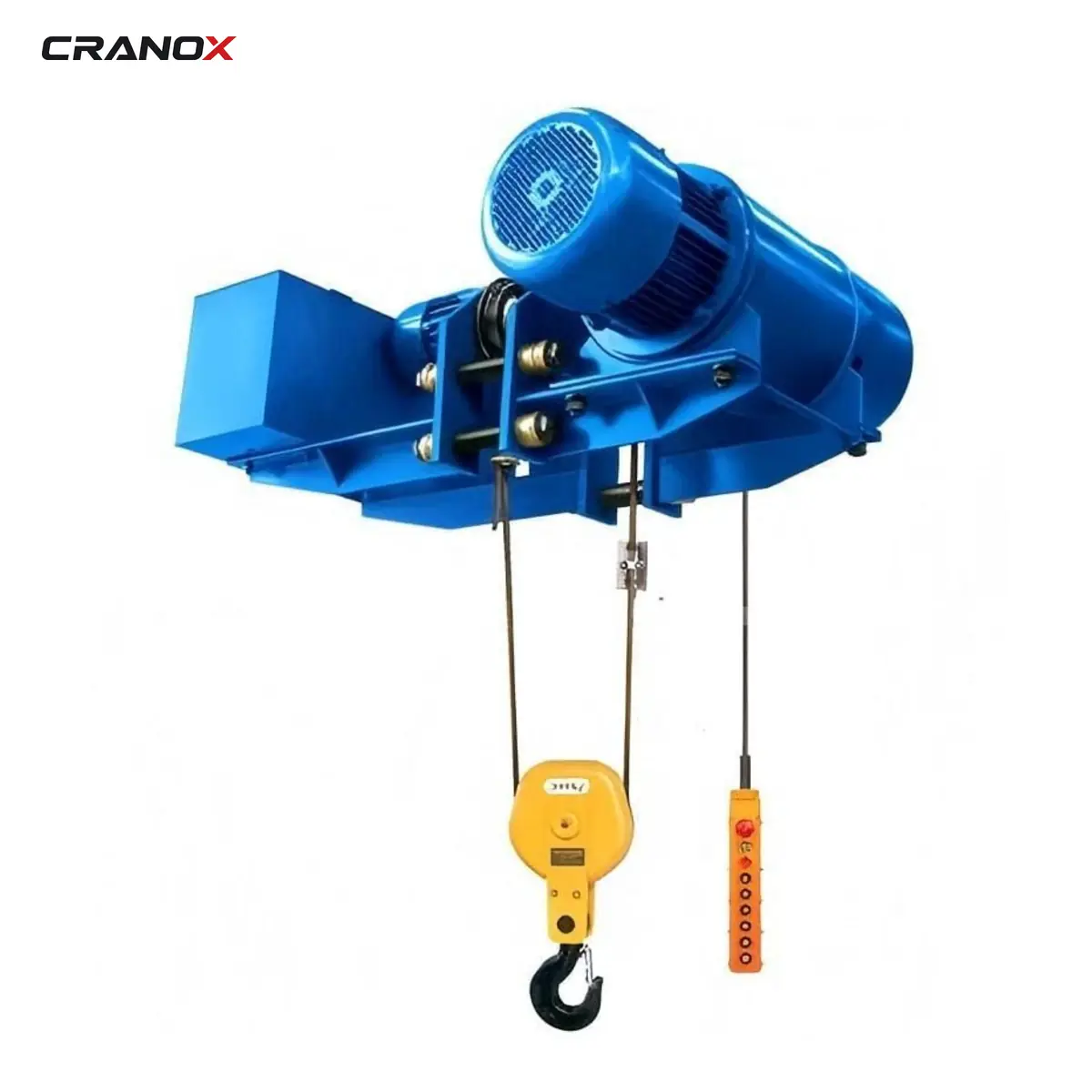
A wire rope hoist is a lifting device that uses a high-strength steel wire rope wound around a grooved drum to raise and lower loads. The lifting mechanism is typically driven by an electric motor through a gearbox.
Electric wire rope hoists are widely used in industrial environments where high lifting capacities, long lifting heights, and frequent material handling operations are required.
Key Characteristics of Wire Rope Hoists
Higher Lifting Capacity
Wire rope hoists are commonly available in medium- and high-capacity configurations. Heavy-duty designs can handle substantial loads, making them suitable for demanding industrial lifting applications.
Lifting Speed and Height
Wire rope hoists can be configured for relatively high lifting speeds and long lifting heights. Drum dimensions, rope reeving arrangements, motor power, and operating requirements determine the actual performance.
Duty Classification
Wire rope hoists are available in different duty classifications to accommodate varying load spectra and operating frequencies. Heavy-duty models can be designed for frequent lifting operations and demanding production schedules.
Load Positioning
Certain wire rope hoist designs can provide near-vertical hook movement with limited horizontal displacement. However, actual hook drift depends on the drum design, rope reeving arrangement, and hoist configuration.
Maintenance Requirements
Regular inspection is necessary to monitor wire rope wear, broken wires, corrosion, deformation, and lubrication conditions. The drum, sheaves, brakes, and transmission components also require periodic maintenance.
Typical Applications
- Heavy manufacturing facilities
- Steel mills and metal processing plants
- Double girder overhead cranes
- Industrial gantry cranes
- Machinery assembly and heavy equipment handling
02. What Is a Chain Hoist?
A chain hoist is a lifting device that uses a high-strength welded link chain running over a load sprocket to raise and lower loads.
Electric chain hoists generally feature a compact lifting mechanism consisting of an electric motor, gearbox, load chain, sprocket, and braking system.
They are commonly used for light- to medium-duty material handling, workstation lifting, equipment maintenance, and assembly operations.
Key Characteristics of Chain Hoists
Compact Design
Electric chain hoists generally have a compact structure, making them suitable for installations with limited space. However, available headroom depends on the specific hoist configuration, suspension arrangement, and trolley design.
Precise Load Positioning
Chain hoists can provide controlled lifting and positioning, particularly when equipped with dual-speed motors or variable frequency drives.
Flexible Installation
Chain hoists can be installed on fixed suspension points, manual or electric trolleys, jib cranes, and light crane systems.
Cost-Effective for Lower Capacities
For many lower-capacity applications, chain hoists offer a practical balance between purchase cost, installation requirements, and maintenance needs.
Maintenance Requirements
Regular inspection should focus on load chain wear, elongation, corrosion, deformation, lubrication, and the condition of the load sprocket and braking system.
Typical Applications
- Assembly lines and workstations
- Jib cranes and light crane systems
- Machinery maintenance workshops
- Warehouses and production facilities
- Equipment installation and component handling

03. Wire Rope Hoist vs Chain Hoist: Technical Comparison
Although both lifting mechanisms perform the same basic function, their mechanical structures and typical applications differ.
| Comparison Factor | Wire Rope Hoist | Chain Hoist |
|---|---|---|
| Lifting mechanism | Steel wire rope and drum | Load chain and sprocket |
| Typical capacity | Medium to very high | Low to medium, with higher-capacity models available |
| Lifting height | Well suited to long lifting heights | Depends on chain length and chain storage arrangement |
| Lifting speed | Suitable for high-speed configurations | Suitable for controlled lifting; speed varies by model |
| Duty classification | Wide range, including heavy-duty applications | Wide range depending on design |
| Equipment dimensions | Often larger, especially at higher capacities | Generally compact at lower capacities |
| Headroom | Low-headroom designs available | Compact designs available |
| Maintenance focus | Wire rope, drum, sheaves, and transmission | Load chain, sprocket, and transmission |
| Common applications | Heavy-duty overhead and gantry cranes | Jib cranes, workstations, and light crane systems |
The comparison above describes common industrial configurations. Actual performance depends on the manufacturer’s design, rated capacity, duty classification, and technical specifications.
04. How to Choose Between a Wire Rope Hoist and a Chain Hoist
Selecting the right electric hoist requires more than comparing rated lifting capacities.
Several technical parameters should be evaluated before making a decision.
Lifting Capacity
Start by identifying the maximum load weight, including lifting attachments and accessories.
For lower-capacity lifting tasks, an electric chain hoist may offer a compact and economical solution.
For higher-capacity applications, especially where heavy loads are handled frequently, a wire rope hoist is often a practical choice.
However, capacity alone should not determine the final selection.
Lifting Height
Consider the required vertical lifting distance.
Wire rope hoists are often preferred for long lifting heights because their drum and reeving arrangements can be engineered for extended vertical travel.
Chain hoists can also accommodate substantial lifting heights, but chain storage, equipment dimensions, and operating requirements must be considered.
Duty Cycle and Operating Frequency
A hoist used occasionally for equipment maintenance has different requirements from one operating throughout multiple production shifts.
Consider the load spectrum, number of operating cycles, running time, and required duty classification.
Both wire rope and chain hoists are available in different duty ratings, so the selected model must match the actual working conditions.
Available Headroom
In facilities with limited ceiling height, the hoist’s installation dimensions can significantly affect the available hook lifting height.
Both wire rope and chain hoists are available in compact or low-headroom configurations.
Compare the actual hook approach dimensions and installation drawings rather than assuming that one hoist type always provides better headroom.
Lifting Speed and Positioning Requirements
High-throughput material handling operations may require faster lifting speeds to reduce handling time.
Precision assembly tasks may require slower, controlled lifting movements.
Depending on the application, dual-speed control or variable frequency drives can help improve load positioning and operational flexibility.
Maintenance and Operating Environment
Consider the operating temperature, humidity, dust, corrosion exposure, and maintenance accessibility.
Wire rope hoists require regular inspection of the rope and associated components, while chain hoists require careful monitoring of the load chain and sprocket system.
Both types must be inspected and maintained according to the manufacturer’s instructions and applicable safety requirements.
05. Which Electric Hoist Is Better for Your Application?
There is no single hoist type that is best for every industrial application.
A wire rope hoist is often suitable when the project involves higher lifting capacities, long lifting heights, demanding production schedules, or heavy-duty overhead and gantry crane systems.
A chain hoist may be more suitable for compact lifting installations, workstation handling, jib cranes, maintenance operations, and many lower-capacity applications.
The final decision should be based on the complete lifting requirements, including capacity, lifting height, duty classification, available space, operating environment, and budget.
Frequently Asked Questions
Is a wire rope hoist better than a chain hoist?
Neither type is universally better. Wire rope hoists are often preferred for higher-capacity and long-lift applications, while chain hoists are commonly selected for compact installations and lower-capacity material handling.
Which hoist is better for heavy-duty lifting?
Wire rope hoists are widely used in heavy-duty industrial applications. However, both wire rope and chain hoists can be designed for different duty classifications. The equipment should be selected according to its rated duty and actual operating conditions.
Which hoist requires less maintenance?
Both require regular inspection and preventive maintenance. Wire rope hoists require inspection of the rope, drum, and sheaves, while chain hoists require inspection of the load chain and sprocket. Maintenance requirements depend on the equipment design and operating conditions.
Can a chain hoist be used on an overhead crane?
Yes. Electric chain hoists can be used on certain overhead crane systems, particularly light-duty and workstation crane applications. The suitability depends on the crane design, capacity, and operating requirements.
Conclusion
Understanding the differences between wire rope hoists and chain hoists helps ensure that lifting equipment is selected according to actual industrial requirements.
Wire rope hoists are commonly used for higher-capacity, long-lift, and demanding material handling applications, while chain hoists offer compact and flexible solutions for many workstation and light- to medium-capacity lifting tasks.
Before selecting an electric hoist, evaluate the lifting capacity, lifting height, duty cycle, available headroom, lifting speed, and working environment.
Find the Right Electric Hoist for Your Project
Cranox is a crane and lifting equipment manufacturer in China with more than 20 years of manufacturing experience.
We supply electric wire rope hoists, electric chain hoists, overhead cranes, gantry cranes, and customized lifting solutions for different industrial applications.
Whether you need a hoist for a new crane system or an existing lifting installation, our technical team can help you evaluate the appropriate equipment configuration.
Contact Cranox for technical support and a customized quotation.
Website: https://cranoxlifting.com/


 English
 Español
 Русский