
Overhead Crane Components: 8 Main Parts and Their Functions
An overhead bridge crane lifts and moves materials in factories, workshops, warehouses, and other industrial facilities. Its operation relies on several structural, mechanical, and electrical systems working together.
The main overhead crane components include the bridge girders, end trucks, hoist, trolley, drive mechanisms, electrical controls, and safety devices. The runway system provides the fixed support and travel path for the moving bridge.
Understanding these components helps you discuss technical requirements, compare crane configurations, and select equipment that fits your facility.
Overhead Crane Components at a Glance
| Component | Main Function |
|---|---|
| Bridge girders | Span the crane bay and support the trolley and hoist |
| End trucks | Support the bridge and allow it to travel along the runway |
| Hoist | Raise and lower the load |
| Trolley | Move the hoist across the bridge |
| Motors, gearboxes, and brakes | Drive, regulate, and stop crane movements |
| Electrical system and controls | Supply power and allow operators to control movement |
| Safety devices | Help restrict movement and manage operational risks |
| Runway system | Support and guide bridge travel |

1. Bridge Girders: Supporting the Hoist and Trolley
The bridge girders are the main horizontal load-bearing members of an overhead crane. They span the crane bay and transfer loads from the trolley and hoist to the end trucks.
There are two common arrangements:
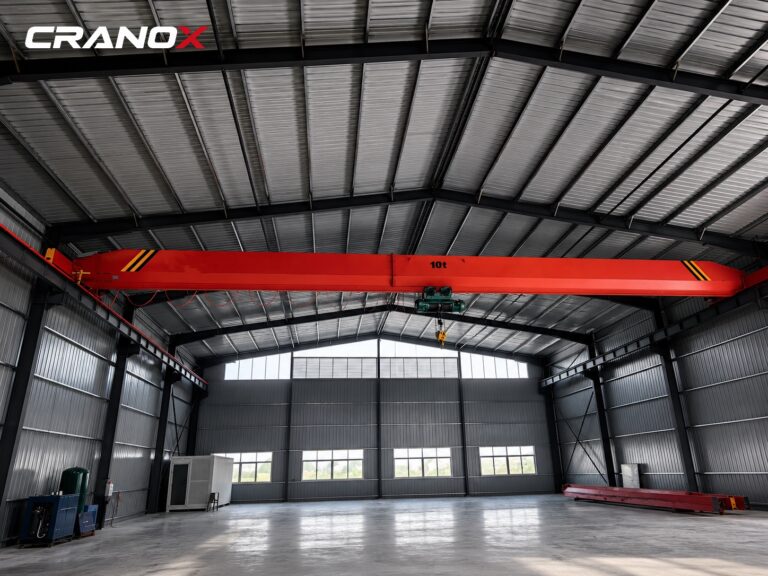
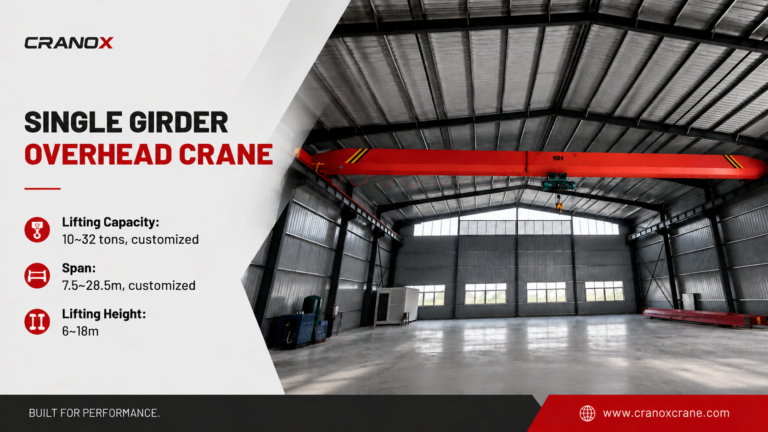
- Single-girder overhead cranes use one main bridge girder.
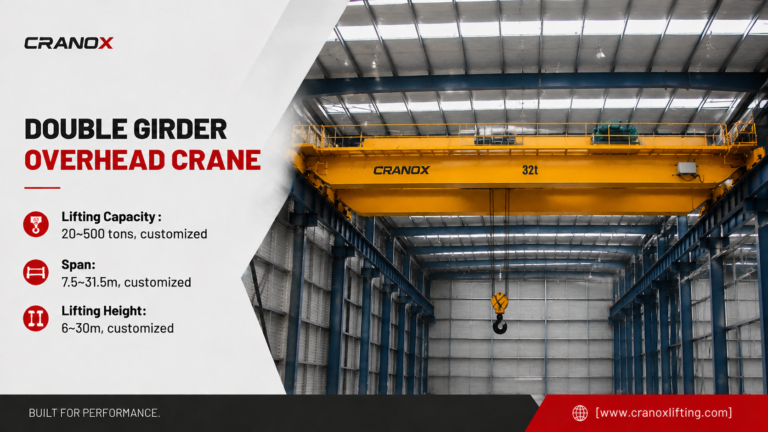
- Double-girder overhead cranes use two main bridge girders.
The appropriate arrangement depends on lifting capacity, span, required hook height, operating duty, and installation conditions.
Girder design must account for the crane’s own weight, the lifted load, and the forces generated during lifting and travel. Capacity alone is therefore insufficient to determine the required structure.
2. End Trucks: Moving the Bridge Along the Runway
End trucks, also called end carriages, connect to the ends of the bridge and contain the travel wheels and associated components.
On a top-running overhead crane, these wheels run on rails above the runway beams. On an under-running crane, the end trucks travel along the lower flanges of suitable runway beams.
The end trucks allow the bridge to move lengthwise through the facility. This movement is called bridge travel or long travel.
Correct wheel alignment and compatibility between the end trucks, drives, and runway are essential for smooth movement and reduced wear.
3. Hoist: Raising and Lowering the Load
The hoist provides the crane’s vertical lifting movement. Electric overhead cranes commonly use wire rope hoists or chain hoists.
A typical electric wire rope hoist includes a motor, gearbox, brake, rope drum, wire rope, and hook block. An electric chain hoist uses a load chain and load sprocket instead of a wire rope and drum arrangement.
Important hoist selection factors include:
- Rated lifting capacity
- Required lifting height
- Lifting speed and positioning needs
- Operating duty and frequency of use
- Available headroom
The hoist arrangement also affects the highest position the hook can reach, making it particularly important in buildings with limited clearance.
4. Trolley: Moving the Hoist Across the Bridge
The trolley supports the hoist and moves it horizontally across the bridge. This movement is known as trolley travel or cross travel.
On many single-girder cranes, the hoist trolley runs along the lower flange of the main girder. Double-girder cranes commonly use a trolley that runs on rails above the two bridge girders.
The hoist lifts the load, while the trolley moves the hoist across the crane span. Although they perform different functions, they may form an integrated hoist-and-trolley assembly.
Combined with bridge travel, trolley travel allows the hook to reach different positions within the crane’s working area.
5. Motors, Gearboxes, and Brakes: Driving Crane Movement
An electric overhead crane typically has drive mechanisms for hoisting, trolley travel, and bridge travel.
Motors provide power, while gearboxes transmit torque and reduce rotational speed to suit each mechanism. Brakes stop movement and, in the hoisting mechanism, hold the suspended load as designed.
The configuration depends on the crane’s capacity, duty, travel speeds, and positioning requirements.
Variable-frequency drives, or VFDs, may be specified to control motor speed and provide smoother acceleration and deceleration. Their suitability should be assessed for each motion and application.
6. Electrical System and Operator Controls
The electrical system distributes power and manages the crane’s movements. Depending on the design, it may include conductor bars, festoon cables, electrical panels, motor drives, and control circuits.
Common operator control options include:
- Pendant control for wired operation from floor level
- Radio remote control for operation from suitable positions within the working area
- Cabin control for applications requiring an onboard operator
The choice depends on visibility, working conditions, travel distances, and how the operator needs to coordinate with other personnel.
Electrical equipment should also suit the environment, including expected dust, moisture, temperature, or corrosive exposure.
7. Safety Devices: Supporting Controlled Operation
Overhead crane safety devices help manage specific risks. Depending on the configuration and applicable requirements, these may include overload protection, lifting and travel limit switches, emergency stops, buffers, and warning devices.
Each has a different purpose. For example, a hoisting limit switch restricts movement at a defined lifting position, while a buffer absorbs some of the impact when a crane or trolley contacts an end stop.
These devices support safe operation alongside proper design, trained operators, inspections, and maintenance. Their presence does not remove the need to operate within the crane’s rated limits.
8. Runway System: Supporting and Guiding Bridge Travel
The runway system provides the fixed path along which the bridge travels. Its arrangement depends on whether the crane is top-running or under-running.
A top-running system typically includes runway rails, supporting beams, connections, and building columns or independent support structures.
Although the runway is generally part of the installation rather than the moving crane, it directly affects crane performance. Alignment, structural capacity, and connections must suit the crane’s wheel loads and operating forces.
Before installing a crane in an existing building, the runway and supporting structure should be assessed for the proposed equipment.
How Do Overhead Crane Components Work Together?
An overhead bridge crane combines three main movements:
- Hoisting: The hoist raises and lowers the load.
- Cross travel: The trolley moves the hoist across the bridge.
- Long travel: The bridge moves along the runway.
Together, these movements allow the hook to serve a generally rectangular working area. The actual coverage depends on hook approaches, travel limits, and the crane’s configuration.
The drive mechanisms power these movements, while the electrical controls allow the operator to direct them. The supporting structure and protective devices help the system operate within its designed limits.
What Should You Consider When Selecting an Overhead Crane?
Selecting an overhead crane requires checking how the complete system fits the lifting task and the building.
Alongside lifting capacity, consider span, lifting height, available headroom, travel distance, load characteristics, operating frequency, positioning accuracy, and environmental conditions.
For an existing workshop, building drawings and runway information can help identify installation constraints early. Two cranes with the same rated capacity may require different girders, hoists, drives, or controls because their working conditions differ.
Frequently Asked Questions About Overhead Crane Components
What is the difference between a hoist and an overhead crane?
A hoist raises and lowers a load. An overhead crane combines the hoist with a bridge, trolley, travel mechanisms, and controls to move loads vertically and horizontally within a working area.
What is the difference between bridge travel and trolley travel?
Bridge travel moves the entire bridge along the runway, usually lengthwise through the workshop. Trolley travel moves the hoist across the bridge, along the crane span.
Do single-girder and double-girder cranes use the same components?
They share the same basic component categories, including girders, end trucks, hoisting equipment, drives, and controls. However, their girder structures and trolley arrangements differ, affecting headroom, hook approaches, and installation requirements.
Is the runway included in an overhead crane quotation?
This depends on the supplier’s scope. Runway rails, beams, columns, installation, and building modifications may be quoted separately. Confirm the supply boundary when comparing offers.
Discuss Your Overhead Crane Requirements with Cranox
Cranox provides overhead crane solutions based on your lifting tasks, workshop layout, and operating conditions, with support from design and manufacturing through installation and after-sales service.
Send us your required capacity, span, lifting height, and workshop drawings or photos to discuss a suitable configuration.


 English
 Español
 Русский